


In 2015, the state of Washington began investigating two enrolled members of the Tulalip Tribes for alleged illegal shellfish trafficking. More than six years later, the charges have been dismissed, but the men’s fish-buying business is shuttered, and they say broader concerns of state interference in tribal sovereignty remain unaddressed.
The Washington Department of Fish and Wildlife investigation into Hazen Shopbell and Anthony Paul, who owned one of Puget Sound’s largest fish-buying operations, came amid complaints from non-Indigenous fish buyers about loss of business resulting from an alleged monopoly involving tribal fishers. While the resulting criminal charges didn’t produce any convictions, Shopbell and Paul say the ordeal led to the collapse of their business and ended a period of fairer prices for the crab and fish caught by Indigenous people.
The case officially concluded last month after Skagit County and state prosecutors declined to appeal a judge’s ruling dismissing the charges on treaty rights grounds. Now, tribal governments and treaty rights organizations in Washington are drawing attention to the case as an example of how, they say, the state isn’t fully respecting tribal sovereignty.
Shopbell said he is relieved that the prosecution is over, but, like others, he worries that he won't be the last example of Washington officials and agencies interfering with tribal citizens who want to exercise treaty rights. And despite the saga’s consequences for him, he believes his case has at least raised awareness about the issue.
“I’m grateful it’s over,” Shopbell said, before adding: “The way I see it, I think it's just the beginning.”
Washington tribes and treaty rights advocates say the concerns over treaty fishing and shellfishing rights are longstanding, arguing that the Fish and Wildlife Department and other state officials have resisted court rulings, like the landmark 1970s Boldt Decision in the case of U.S. v. Washington. That ruling upheld treaty fishing rights and guaranteed co-management of state fisheries with tribes.
The Fish and Wildlife Department said its investigation of Shopbell and Paul was proper and didn’t violate tribal sovereignty, and that larger concerns about hostility toward treaty rights are unfounded. Still, treaty rights organizations, tribes and others are pressing state leaders to address their concerns.
Not addressing those issues, said Gabe Galanda, a Seattle tribal rights attorney who represented Shopbell in the criminal case and Paul in a related civil case, could mean Indigenous people interested in starting a similar business may be discouraged from doing so out of fears of legal action.
“They're afraid they will be the next to be persecuted and prosecuted,” he said. “The status quo has been restored, as it was before.”
‘I’ll give my life for this’
Many Washington tribes signed treaties with the federal government in the 1850s that guaranteed their rights to fish and hunt in their traditional homelands. The state of Washington’s refusal to recognize those rights led to the “Fish Wars” of the 1960s and 1970s.
Then, in 1974, a federal judge affirmed those treaty rights in the Boldt Decision. That ruling recognized the tribes as co-managers of the state’s fisheries and guaranteed tribes half of the harvestable catch in Washington. Subsequent court rulings reinforced those rights or expanded them to shellfish, for example.
When the Fish and Wildlife Departmenta launched its investigation in 2015, Shopbell and Paul owned and operated a multimillion-dollar wholesale seafood distribution company, Puget Sound Seafood Distributors. The business had become one of the state’s largest wholesale seafood distributors by offering higher prices to Indigenous fishers for their catches, helping to corner the Coast Salish market.
Shopbell said he first got the idea to start a business like the one he operated with Paul after hearing complaints from family members and other tribal members about getting low prices for their catches.
That, according to Galanda, didn’t sit well with non-Indigenous businesses, who complained to the Fish and Wildlife Department about an allegedly illegal monopoly.
Those complaints kicked off a department investigation in 2015 that would eventually lead to felony charges in Skagit County for Shopbell and Paul for illegal trafficking of bait. The department had already presented the same charges to several other counties, which declined to prosecute. A judge would later say he was troubled by the department “shopping the prosecution” to those counties.
In 2019, the Skagit County Superior Court dismissed the trafficking charges after a judge said the Fish and Wildlife Department had seized evidence — bait clams — without a warrant and then failed to properly preserve it, while acknowledging — but without issuing a ruling — that the two men had a treaty rights defense.
After an appeal from Skagit County prosecutors, a state appeals court returned the case to the lower court, saying the judge had to determine whether Fish and Wildlife agents acted in bad faith during the investigation.
Late last year, the Skagit County court dismissed the charges, saying the state didn’t have jurisdiction in the matter in the first place. The case formally came to an end last month, when Skagit County prosecutors declined to appeal the ruling.
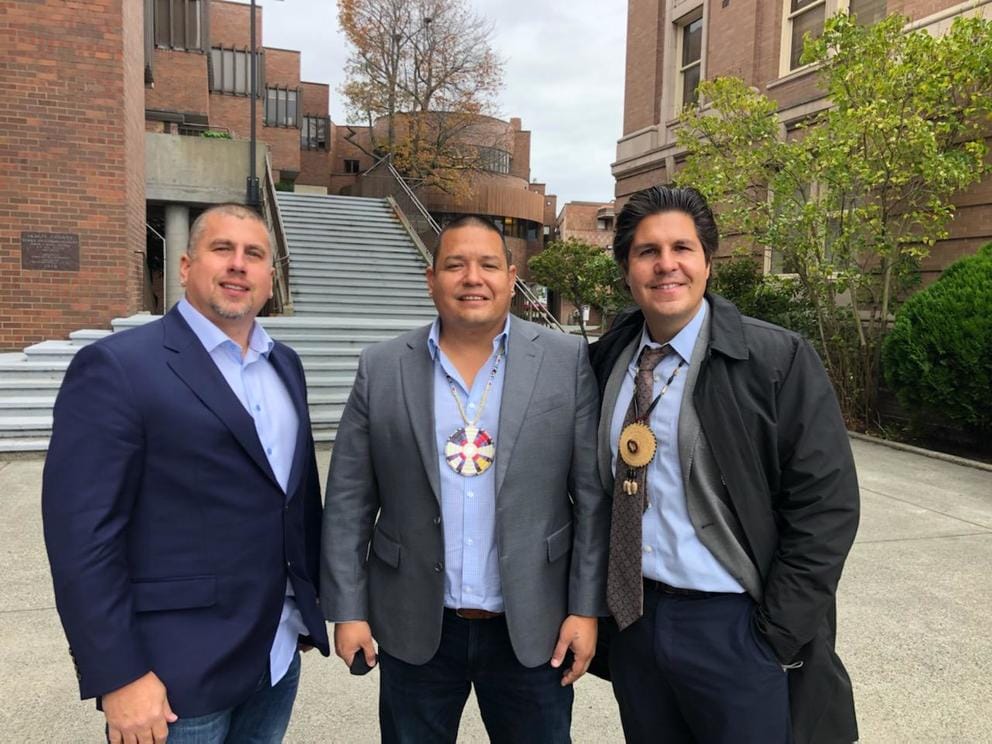
Anthony Paul, left, and Hazen Shopbell, middle, with attorney Gabe Galanda. (Courtesy of Gabe Galanda)
A concurrent prosecution of Paul and three other men for shellfish trafficking in Pierce County was also dismissed in 2018 after the prosecutor revealed that the Fish and Wildlife Department had withheld vital information from the prosecutor’s office that “would be a complete defense in this case,” according to the prosecutor’s dismissal memo.
Fish and Wildlife’s arrests also led to a federal civil rights lawsuit from Shopbell and Paul. Some of the claims were dismissed because the department had immunity from the lawsuit, but last year the agency settled claims of wrongful arrest of the two men for $50,000.
Galanda, a member of the Round Valley Indian Tribes of California, said he’s represented Indigenous clients in the past who faced Fish and Wildlife investigations and potential prosecution. In those cases, he said, clients made deals with the state to settle their cases in order to get their property back and move on with their lives, often because they didn’t have the resources for a drawn-out legal fight.
That kept the issue from gaining widespread attention, he said. But Shopbell and Paul were different because they decided to fight the charges, which helped highlight how the Fish and Wildlife Department interferes in tribal treaty rights, Galanda said.
Shopbell said “there was no settling with me” and that he intends to fight the case to the end, no matter what the consequences could be.
“These guys have been coming after us for years, decades,” he said. “I'll give my life for this. That's how much it meant to me.”
Pressing for answers
To Shopbell, his case illustrates how Washington officials haven’t moved on from fighting against treaty rights in the Fish Wars of the 1960s and ’70s.
Others express similar concerns.
In late January, the Affiliated Tribes of Northwest Indians, an organization with 57 member tribes that advocates for tribal interests in the region, passed a resolution during its winter conference calling on Washington Gov. Jay Inslee or state Attorney General Bob Ferguson to investigate the Fish and Wildlife Deprtment for potential violations of law or policy stemming from its investigation of Shopbell and Paul.
The organization also called for the department to disclose the cost associated with the investigation and prosecution, as well as a moratorium on the department impounding tribal citizen boats or vehicles taken on treaty lands or waters.
In a response to questions from a reporter, a Ferguson spokesperson provided a Feb. 17 letter to the Affiliated Tribes of Northwest Indians responding to its resolution. The letter didn’t say whether it would investigate itself or the Fish and Wildlife Department, as the organization had requested, but indicated that Ferguson didn’t believe his office had violated any laws or policies.
“I look forward to working with you on these and other issues,” Ferguson said in his letter. “I strive to be a strong partner with Indian Country, and fully support the Affiliated Tribes of Northwest Indians’ efforts to support tribal self-determination.”
The affiliated tribes’ resolution followed an October letter from the Northwest Indian Fisheries Commission to the Fish and Wildlife Department that raised concerns about “discriminatory or illegal enforcement actions against tribal members in treaty territories and waters,” where tribal governments have the primary fisheries enforcement authority over Indigenous treaty fishers. The Tulalip Tribes have also protested the charges through letters to state officials.
“From our standpoint, it appears WDFW is focusing its enforcement efforts against tribal members who typically do not have the resources to defend themselves,” the letter from Northwest Indian Fisheries Commission Executive Director Justin Parker said. “WDFW is violating treaties and federal, state, and tribal laws in the process. That is no way to co-manage our fisheries resources.”
A department spokesperson provided a letter it sent to the Northwest Indian Fisheries Commission denying allegations that it intentionally targets tribal citizens for investigations or that it works to undermine treaty rights or tribal sovereignty. In the Oct. 28 letter, Kelly Susewind, director of the Fish and Wildlife Department, said it was inappropriate for NWIFC to write a letter that he alleged appeared to have been intended to influence the court case against Shopbell and Paul. He added that his agency and tribal fisheries and natural resource agencies have increasingly worked together on enforcement issues.
“The empty allegations in your letter appear to be designed to discredit these gains and are counterproductive to fostering cooperation between co-managers,” Susewind said.
Susewind also said the department disagreed with the court’s ruling and Skagit County’s decision not to appeal. Moreover, he said, the agency believed the state had jurisdiction in the matter and that Paul and Shopbell’s treaty rights were improperly applied.
Mike Faulk, a spokesman for Inslee, said his office hadn’t seen the Affiliated Tribes of Northwest Indians resolution, but that the governor was aware of the “complex and lengthy cases.”
“We expect and will continue to encourage the [Fish and Wildlife Department] to operate in a professional, fair and respectful manner,” he said.
While it’s unclear if the appeals from groups like Affiliated Tribes of Northwest Indians and Northwest Indian Fisheries Commission will result in an investigation or broader changes, Galanda said the result of Paul and Shopbell’s case and attention from it might make the Fish and Wildlife Department more hesitant to pursue cases against tribal citizens that interfere with tribal sovereignty.
“They might think twice about further violating treaty fishing and territorial rights,” he said. “But that doesn't mean that they won't come back and do that again.”
‘I would do it all over again’
Before the investigation, Shopbell and Paul’s business was booming. And, according to Shopbell and Galanda, tribal treaty fishers were finally getting fair prices for their catches. But the business failed in the wake of the investigation, Galanda said, because few people wanted to be associated with a business that was facing public legal scrutiny.
Since then, Galanda and Shopbell said no other Indigenous people have stepped in to fill the void on a similar scale left when Shopbell and Paul’s business failed. That has meant tribal fishers are once again confronting depressed prices for their catches, they said.
But Shopbell, who in 2020 was elected to the Tulalip Tribes’ Board of Directors, said he would fight the charges again if it meant fortifying treaty rights and sovereignty. He believes the result of the case, despite the loss of a multimillion dollar business and years of stress from court hearings, was a positive for Washington tribes.
“I’m telling you, I lost everything. … I’m OK with that, if that’s what it takes,” he said. “I would do it all over again if I had to. That's how much I care about our treaty rights and how much it means to me, and knowing what our ancestors went through to preserve those.”
Shopbell said he’ll continue to push for the state to respect tribal treaty rights. Ultimately, he hopes his case prompts Washington tribes to be assertive when dealing with the state to protect tribal sovereignty and treaty rights.
He said he recently bought a crab fishing boat and is looking forward to using it with his family. Someday, he added, he might even try to resurrect his wholesale seafood distribution business.
For now, he’s excited to get back out on a boat with his family and teach his kids about harvesting crab and the treaty that guarantees their right to fish as their ancestors had.
“That’s part of healing for me,” Shopbell said. “It’s not the money. It’s getting back and doing what I love to do. There’s nothing better than being on the water. We worked hard to preserve this.”
This story was originally published on March 10, 2022 by Underscore.news and Indian Country Today, a news partnership that covers Indigenous communities in the Pacific Northwest. Funding is provided in part by Meyer Memorial Trust.
